
Therapeutic EUS
Pancreatic and Biliary Drainage in Delhi
EUS-guided drainage of pancreatic fluid collections, bile duct and gallbladder
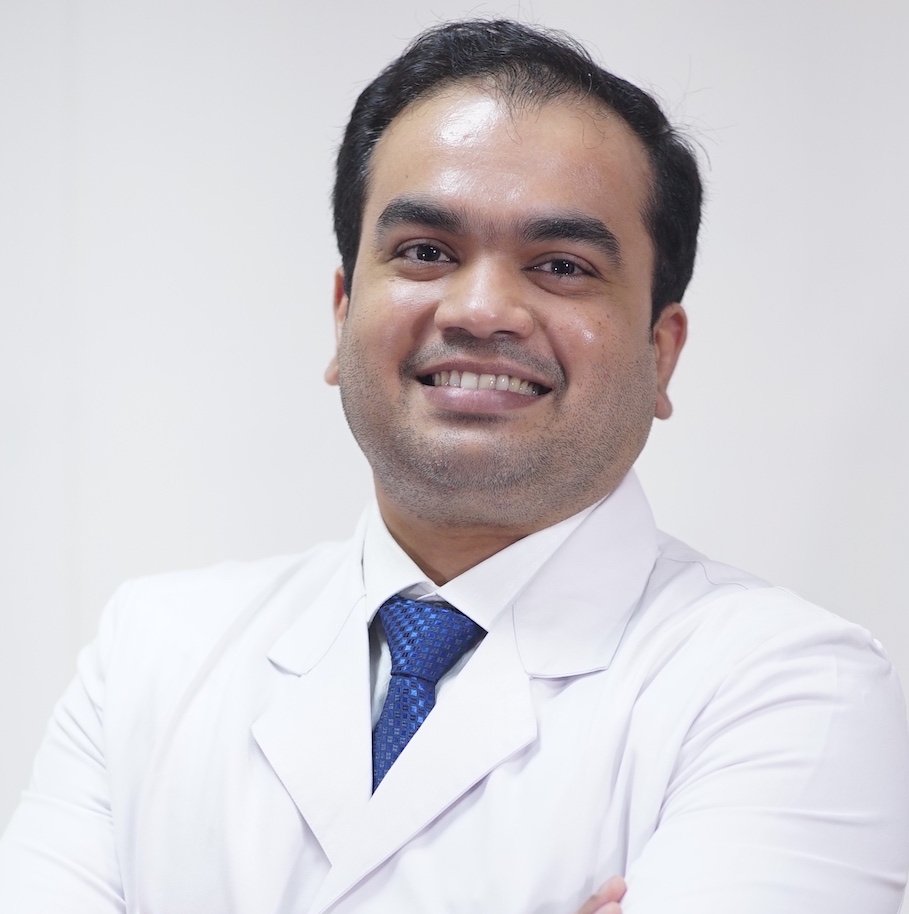
Dr Surakshith T K performs EUS-guided drainage in Delhi for pancreatic pseudocysts and walled-off necrosis, for bile duct obstruction where ERCP is not possible, and for gallbladder drainage in patients unfit for surgery. These are procedures that once required an operation or an external drain.
What is EUS-guided drainage?
EUS-guided drainage uses endoscopic ultrasound to place a stent between the gut and a fluid collection, a blocked bile duct or the gallbladder, creating an internal drainage route without surgery and without an external drain. The ultrasound probe sits a few millimetres from the target, so the puncture is made under direct vision and away from blood vessels. Fluid then drains internally, and the stent is removed endoscopically once the problem has settled.
Indications
What can be drained endoscopically
Drainage is a treatment for a complication, so the decision always starts with why the collection or obstruction is there.
Drainage procedures are part of advanced EUS and therapeutic endoscopy. Where the bile duct can be reached from inside the duodenum, ERCP remains the first approach; EUS-guided drainage is what makes treatment possible when it cannot.
The procedure
How the procedure is done
- Assessment — imaging and EUS confirm the collection, its contents and its relationship to the stomach or duodenum
- Timing — drainage of a collection is usually deferred until the wall has matured, unless there is infection or obstruction
- Puncture — the collection is punctured under ultrasound guidance, avoiding intervening vessels
- Stent placement — a lumen-apposing metal stent or plastic stents are placed to hold the tract open
- Necrosectomy if needed — solid debris is cleared endoscopically through the stent over one or more sessions
- Stent removal — the stent is removed endoscopically once imaging shows the collection has resolved
What to expect honestly
Drainage of walled-off necrosis is often not a single procedure. Several sessions may be needed to clear solid debris, and that is planned from the start rather than presented as a complication.
Bleeding, stent migration and infection are recognised risks, which is why these procedures are done at hospitals with interventional radiology, ICU and surgical backup on site.
Not every pseudocyst needs draining. A collection that is causing no symptoms is often best left alone and watched.
Related
Related procedures
A pancreatic collection or blocked bile duct that needs draining?
Send your CT or MRCP, blood reports and any previous ERCP notes. Whether drainage is needed, when it should be done, and by which route are three separate questions — all three deserve an answer before anything is planned.
- +91 96861 37977
- Kalka Gastro Liver & Obesity Clinic10/22 Nehru Enclave East, Kalkaji, New Delhi 110019
- Mon–Sat, 5:00 pm – 8:30 pmProcedures at Fortis Escorts (Okhla) & Holy Family (NFC)
FAQ
Frequently asked questions
What is walled-off necrosis, and how is it treated?
Walled-off necrosis is a collection of dead pancreatic and surrounding tissue that becomes enclosed by a wall several weeks after severe acute pancreatitis. If it causes pain, fever, obstruction or infection it is drained endoscopically, usually with a lumen-apposing metal stent placed under EUS guidance, and solid debris is cleared through that stent in one or more sessions.
Will I need surgery as well?
In most patients endoscopic drainage avoids an operation. Surgery is still needed in some cases, for example where the collection cannot be reached endoscopically or where endoscopic treatment does not control it. The approach is decided jointly with the surgical team.
How long does the stent stay in?
It depends on what is being drained. A stent placed for a pancreatic collection typically stays for several weeks until imaging shows the collection has resolved, then it is removed endoscopically. Biliary stents follow their own schedule depending on the cause of the obstruction.
- MBBS · MD (Medicine) · DNB (Gastroenterology & Hepatology), Sir Ganga Ram Hospital
- Senior Consultant Gastroenterologist, Hepatologist & Therapeutic Endoscopist
- 250+ third-space procedures · 200+ POEM · 10,000+ ERCP · 5,000+ EUS
- Fortis Escorts Hospital, Okhla · Holy Family Hospital, New Delhi · Kalka Gastro Liver & Obesity Clinic, Kalkaji
- Delhi Medical Council reg. 74686
This page is for general information and does not replace an individual consultation. Whether a procedure is suitable depends on your own reports and examination. Last reviewed September 2026.