
Third-space endoscopy
ESD (Endoscopic Submucosal Dissection) in Delhi
En-bloc endoscopic removal of early gastrointestinal cancers and large flat lesions
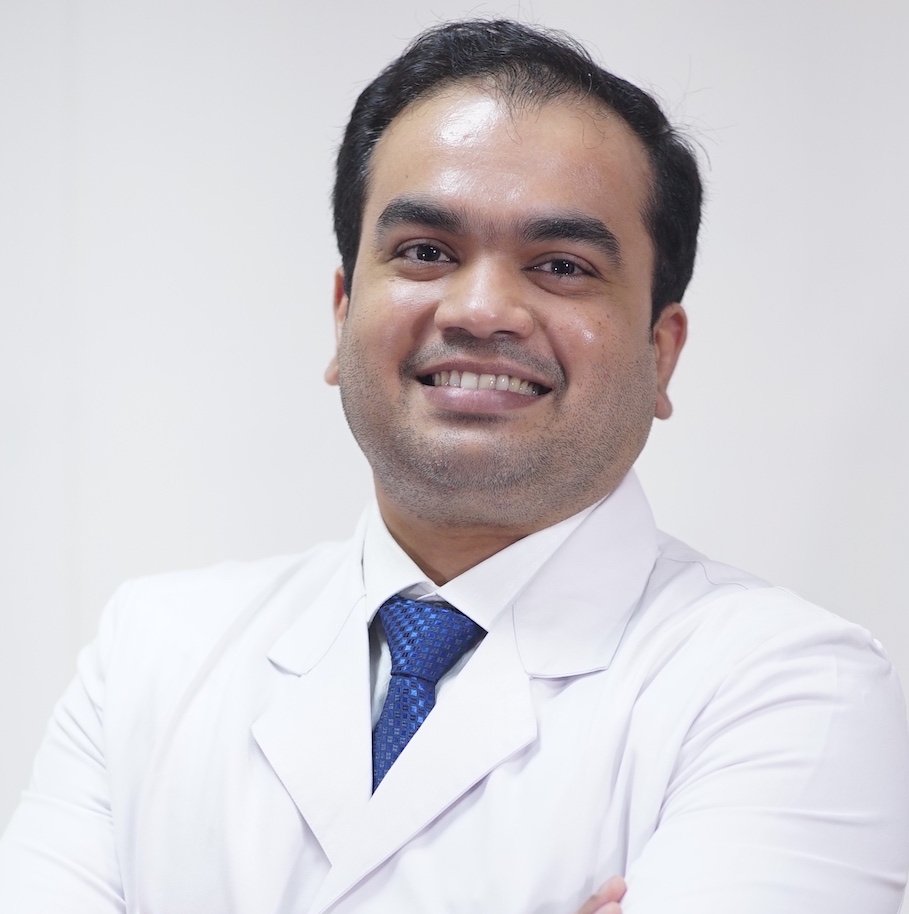
Dr Surakshith T K performs ESD in Delhi for early cancers and large flat lesions of the oesophagus, stomach and colon. He trained in ESD and image-enhanced endoscopy at Jichi Medical University under Dr Hironori Yamamoto and at the Osaka International Cancer Institute under Prof Noriya Uedo — two of the centres where the technique was developed.
What is ESD (endoscopic submucosal dissection)?
ESD is an advanced endoscopic technique in which a lesion in the lining of the oesophagus, stomach or colon is dissected away from the wall underneath it with a fine electrosurgical knife and removed in one piece. Everything is done through the endoscope, under sedation or general anaesthesia, with no external incision. Because the specimen comes out whole, the pathologist can examine every margin and say whether the lesion has been completely removed — which is what turns an uncertain follow-up into a definite answer.
Indications
What ESD is used for
ESD is considered when a lesion is too large, too flat or too suspicious to remove reliably in one piece by other means.
ESD is one of several advanced and third-space endoscopy procedures performed by Dr Surakshith T K in Delhi. Where a lesion is superficial and lifts cleanly, EMR may be enough; where it arises from the muscle layer, EFTR is the appropriate operation.
The procedure
How ESD is performed
- Assessment — the edges and depth of the lesion are defined with image-enhanced and magnifying endoscopy, and with EUS where the depth is in doubt
- Marking — the margin is marked around the lesion with the tip of the knife
- Injection — fluid is injected beneath the lesion to lift it away from the muscle layer
- Circumferential incision — the lining is cut all the way round, outside the marked margin
- Submucosal dissection — the lesion is dissected off the muscle layer and retrieved in one piece
- Closure and recovery — the defect is closed or left to heal, and most patients go home within a day or two
What ESD does not do
ESD removes the lesion; it does not treat disease that has already grown into the deeper layers. That is why depth is assessed carefully beforehand.
Bleeding and perforation can happen during ESD. In experienced hands both are usually dealt with endoscopically in the same sitting.
The specimen decides what happens next. If pathology shows deep invasion or lymphovascular involvement, surgery is advised afterwards — that is not a failure of the procedure, it is the reason the lesion is taken out whole rather than in fragments.
Related
Related procedures
Been told you need surgery for an early GI cancer or a large polyp?
Send your endoscopy report, biopsy and images. Some lesions that have been referred for surgery can be removed endoscopically — and some cannot. You will get a straight answer either way.
- +91 96861 37977
- Kalka Gastro Liver & Obesity Clinic10/22 Nehru Enclave East, Kalkaji, New Delhi 110019
- Mon–Sat, 5:00 pm – 8:30 pmProcedures at Fortis Escorts (Okhla) & Holy Family (NFC)
FAQ
Frequently asked questions
What is the difference between EMR and ESD?
Both remove lesions from the lining of the gut. EMR lifts the lesion with an injection and snares it off, which suits small, clearly superficial lesions but often removes larger ones in several pieces. ESD dissects underneath the lesion with a knife and removes it in one piece however large it is, so the pathologist can assess every margin. ESD takes longer and needs specific training, and is preferred when the lesion is large or flat or when early cancer is suspected.
Who performs ESD in Delhi?
Dr Surakshith T K performs ESD at Fortis Escorts Hospital, Okhla and Holy Family Hospital, New Friends Colony, with assessment and follow-up at Kalka Gastro Liver & Obesity Clinic in Kalkaji, South Delhi. He trained in ESD and image-enhanced endoscopy at Jichi Medical University and the Osaka International Cancer Institute in Japan.
How long does ESD take and how long will I be in hospital?
An ESD usually takes between one and three hours depending on the size and site of the lesion. Most patients stay one to two nights and return to ordinary activity within a week, with a diet plan for the first few days.
- MBBS · MD (Medicine) · DNB (Gastroenterology & Hepatology), Sir Ganga Ram Hospital
- Senior Consultant Gastroenterologist, Hepatologist & Therapeutic Endoscopist
- 250+ third-space procedures · 200+ POEM · 10,000+ ERCP · 5,000+ EUS
- Fortis Escorts Hospital, Okhla · Holy Family Hospital, New Delhi · Kalka Gastro Liver & Obesity Clinic, Kalkaji
- Delhi Medical Council reg. 74686
This page is for general information and does not replace an individual consultation. Whether a procedure is suitable depends on your own reports and examination. Last reviewed September 2026.